
Two open-source Linux kernel modules, gpu-unlock and gpu-unlock-ada, lift the half-rate FP16/BF16 tensor cap on RTX 3090 and RTX 4090 cards. Community tests show faster prompt prefill for local AI, not higher gaming FPS. If you’re weighing a new card instead, start with which graphics card to buy, compare tiers in the 2026 GPU hierarchy, check power with the GPU/PSU wattage calculator or see our AI dev rig build.
- USE IT / UPGRADE COOLING & PSU if: you already own a supported card, can recover a Linux boot and have a repeatable compute-heavy workload. Check power and cooling before experimenting.
- WAIT if: this is your working machine or you need longer stability evidence for your exact GPU and driver.
- SKIP if: you want higher gaming FPS, native Windows support from these Linux modules or more VRAM.
Should you keep a 24GB card or buy a newer GPU?
We may earn a commission when you buy through these links.
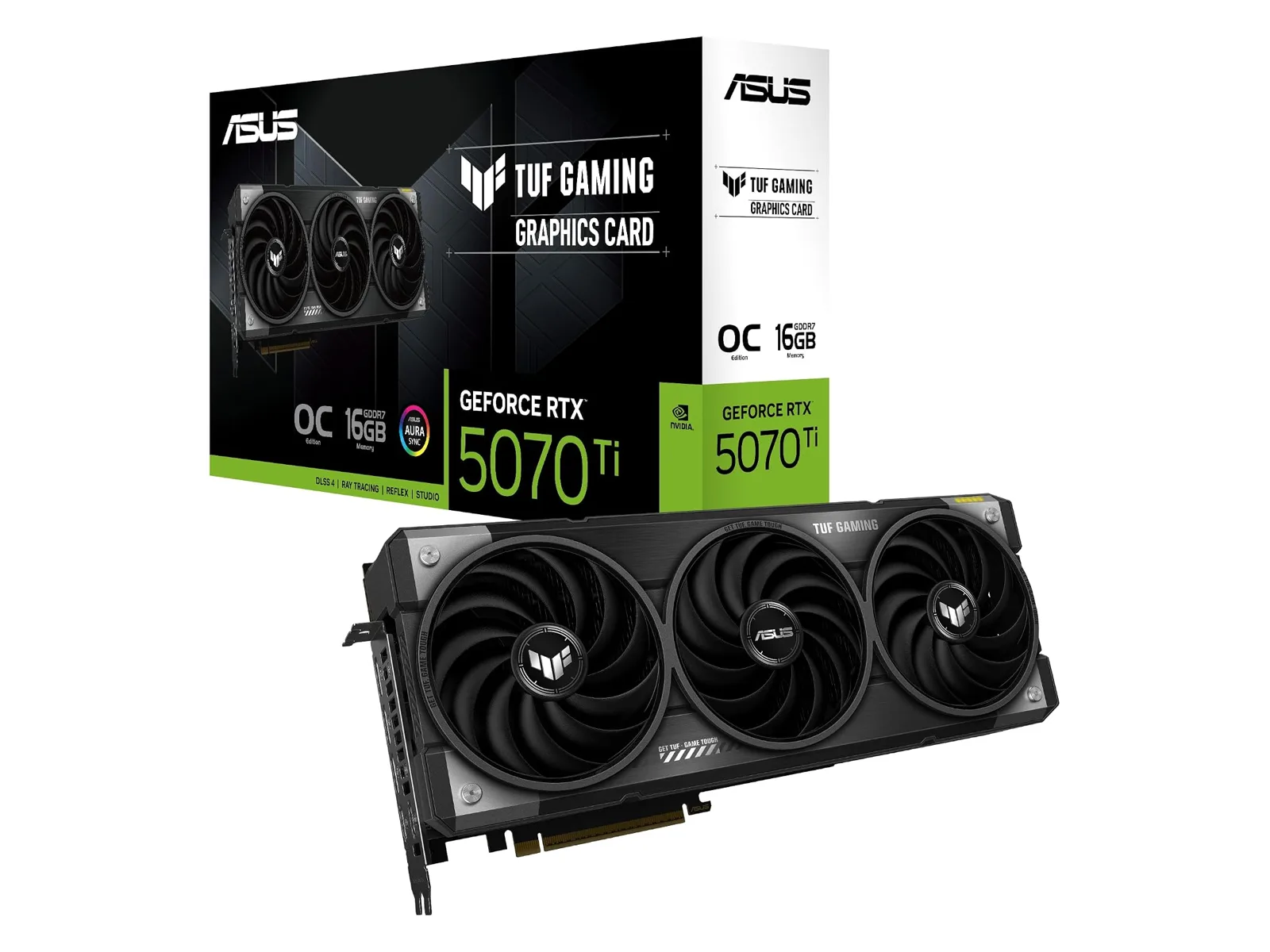
The ASUS TUF RTX 5070 Ti pictured here is a new-card alternative with 16GB GDDR7, not an unlock test subject. Moving from a 24GB RTX 3090 or RTX 4090 to 16GB reduces model capacity. Check the model, context length and software backend before treating newer hardware as an AI upgrade. For a factory-warranty purchase, check the seller’s eligibility and regional warranty terms.
The RTX 3090 tensor unlock changes a specific math limit. It leaves memory capacity unchanged. For games, use the full GPU hierarchy rather than predicting FPS from tensor throughput.
What do the before-and-after results show?
The gpu-unlock project was created on October 18, 2026. JustAResearcher’s Ada fork followed on October 23. Both target FP16/BF16 tensor operations with FP32 accumulation. The documented Ampere results should not be read as confirmation for every RTX 20-series Turing card.
| GPU | Before unlock | After unlock | What the measurement means |
|---|---|---|---|
| RTX 3090 Ti 24GB | 87.50 TFLOPS BF16 | 157.41 TFLOPS BF16, about 1.8x | Dense GEMM at 450 W; five-sample medians |
| RTX 3090 24GB | Each user’s stock baseline | BF16 gains of 25% to 67% | Different user setups; the lowest report used a 225 W cap |
| RTX 4090 24GB (1-card test) | 165.6 TFLOPS FP16 | 331.6 TFLOPS FP16, about 2x | Original single-card instruction-rate proof of concept |
| RTX 5070 Ti 16GB GDDR7 | Factory configuration | No unlock result claimed here | New-card alternative; confirm factory warranty and 16GB model fit |
These rows describe different benchmark methods. They do not establish a ranking for running the same AI model. The RTX 3090 reports also cannot be reduced to a single 350 to 450 W comparison.
RTX 4090 sample caveat: the 331.6 TFLOPS figure comes from the original one-card experiment. The current fork also documents an independent owner’s matched run, so the original number should not be described as the entire evidence available today. Additional runs still do not establish long-term reliability across boards.
Why does prefill improve while token decode barely changes?
Prefill processes the input prompt before an LLM generates its answer. Inference with long prompts can spend substantial time multiplying matrices. Removing an instruction-rate restriction can shorten that stage and help time to first token, depending on the rest of the workload.
The community’s 14% to 36% prefill gains are separate from the near-2x synthetic results. They are not a universal PyTorch or vLLM speedup. LoRA fine-tuning may benefit when it is compute-bound, but these figures do not establish a 14% to 36% LoRA gain.
Token-by-token decode often waits on memory bandwidth. More tensor issue throughput does little for that bottleneck. The projects do not demonstrate higher gaming FPS; ordinary FP32 performance is not the target of this change.
System memory and storage remain separate constraints. Read our RAM guide and DeepSeek V4.1 Flash memory requirements before buying parts for a model that exceeds available memory.
Four limitations to check before experimenting
- Linux modules, without a permanent vBIOS flash. These modules act during boot before the stock NVIDIA driver binds the card. They do not provide native Windows support. Separate experimental ports require their own compatibility evidence.
- Limited RTX 4090 evidence. The headline result is a single-card proof of concept. Check the fork’s current test reports, exact PCI device and driver version rather than assuming every Ada board works.
- Warranty, power and cooling need checking. Treat warranty coverage for low-level modifications as unresolved until the manufacturer confirms the terms for your card. A 450 W GPU experiment demands appropriate cables, cooling and system power headroom; this is not a recommendation to raise a board’s power limit. Start with the GPU/PSU wattage calculator and ATX 3.1 PSU tier guide. An ATX 3.1 label alone does not establish suitability.
- No official NVIDIA endorsement. AiLookout’s October 25 report says it found no public NVIDIA statement. Future driver or firmware compatibility remains uncertain. Keep a stock boot option and read the recovery instructions before making changes.
Which new-card alternatives make sense?
Keep a working 24GB card if your models need its capacity. Consider these catalog options for a separate gaming or smaller-model build; none has an unlock benchmark in this article.
ASUS TUF Gaming RTX 5070 Ti 16GB
For a 16GB NVIDIA software workflow and gaming build. Check case clearance and warranty terms with the seller. The Amazon and B&H buttons near the top of this article link to this same model.
GIGABYTE RTX 5070 Ti WINDFORCE SFF 16G
Another 16GB GDDR7 NVIDIA option. Check the exact board dimensions and power connections against your case and PSU.
ASUS Prime Radeon RX 9070 XT OC Edition 16GB
A gaming alternative for buyers whose applications support AMD. Confirm the AI runtime’s GPU support first; a CUDA-dependent workflow requires a different choice.