
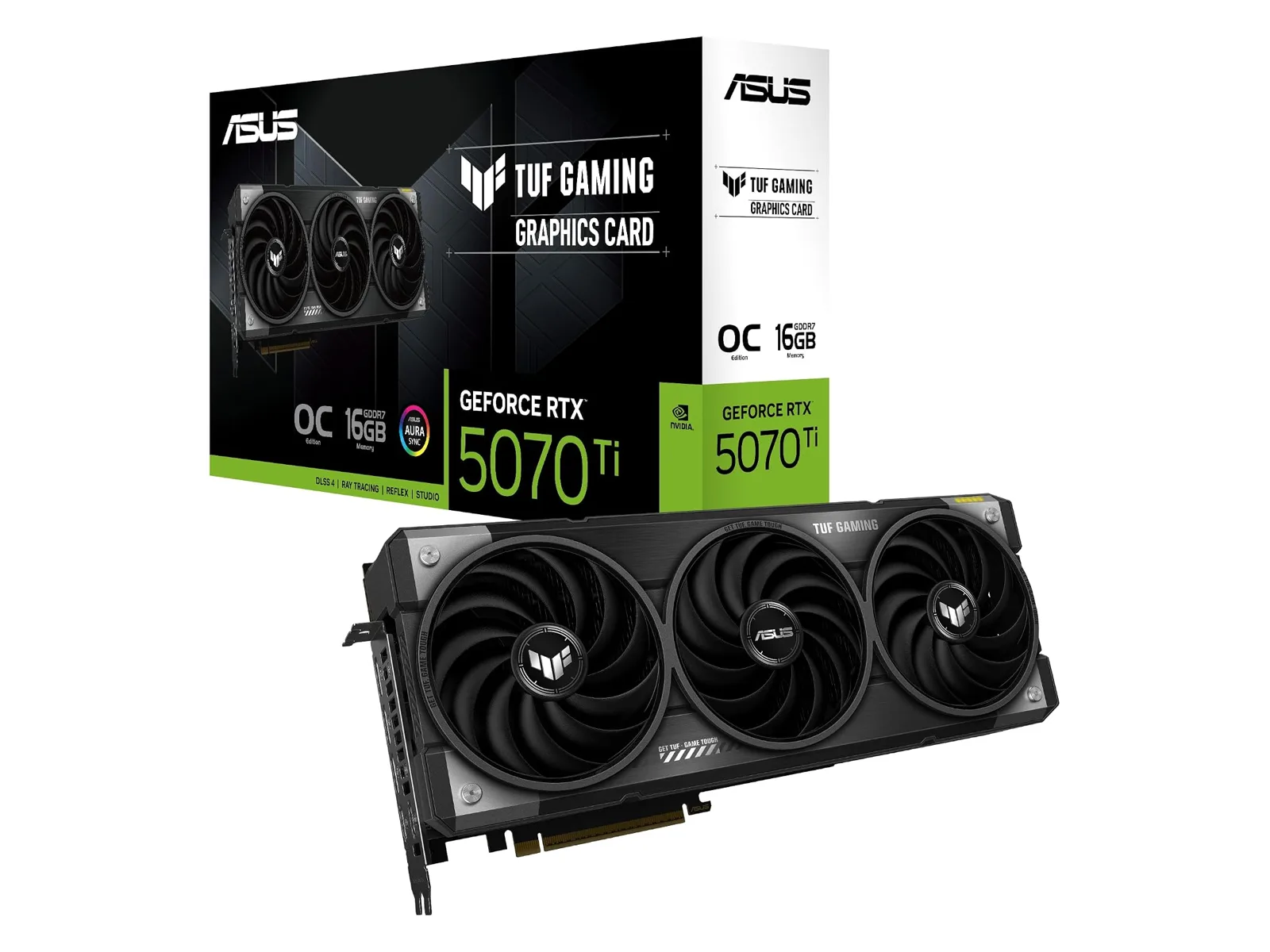
Quick answer: An RTX 5070 Ti 16GB stock check should start with your games, case and power supply. Buy a partner card if you need NVIDIA’s ray tracing or CUDA/NVENC features; compare the Radeon alternative before paying a premium for raster gaming. Start with which graphics card to buy and our RTX 5070 Ti vs RX 9070 XT comparison.
Tom’s Hardware’s October 2026 street-price tracking puts the RTX 5070 Ti median roughly 47% above its launch reference. That market snapshot does not establish the stock, seller or markup of an individual ASUS or GIGABYTE listing.
- BUY NOW if: You need demanding ray tracing at 1440p or 4K, DLSS 4 Multi Frame Generation in supported games, or CUDA/NVENC workflows, and find the ASUS TUF or GIGABYTE WINDFORCE SFF in stock with acceptable seller terms. Tom’s Hardware reports 66.2 fps for the RTX 5070 Ti in its 1440p Ultra ray-tracing average; that is not a 4K result.
- WAIT if: Your case needs a compact cooler, or you do not want to pay the roughly 47% median premium while your current GPU still handles 1440p.
- SKIP if: Your priority is pure 1440p rasterization. Compare the 16GB RX 9070 XT first: Tom’s Hardware places these GPUs close together in raster performance, with a smaller street-price premium for the Radeon.
We may earn a commission when you buy through these links.
Should you buy an RTX 5070 Ti 16GB now or pivot to RX 9070 XT?
Quick answer: Choose the RTX 5070 Ti when its NVIDIA-specific features solve a need you already have. Choose the RX 9070 XT shortlist when raster gaming is the priority. Wait when neither option improves a problem you notice today.
According to NVIDIA, the RTX 5070 Ti has 8,960 CUDA cores and 16GB GDDR7 on a 256-bit bus, with 300W total graphics power. ASUS specifies up to 2,610 MHz in OC mode for the TUF card. That factory clock is a specification, not a promise of a measured improvement in your games.
Why 16GB GDDR7 partner cards are tight in October 2026
Tom’s Hardware’s October buying guide documents a substantial RTX 5070 Ti street-price premium. NVIDIA does not offer a Founders Edition of this GPU, so the purchase decision is between partner designs such as ASUS TUF and GIGABYTE WINDFORCE SFF.
What we know: NVIDIA’s specifications and the board makers’ documentation establish memory, power and physical requirements. Tom’s price tracking establishes a market snapshot. What we do not know: those sources do not establish today’s inventory at a specific retailer or a date when your preferred board will become easier to buy. A premium alone does not establish its manufacturing cause.
For the 16GB vs 12GB VRAM 1440p 2026 decision, NVIDIA lists 12GB GDDR7 on a 192-bit bus for the RTX 5070, versus 16GB on a 256-bit bus for the Ti. Memory capacity is worth checking when choosing Ultra textures, ray tracing and frame-generation settings. Capacity alone does not establish frame rate or prove that every 12GB card is inadequate. Check the games and settings you actually use.
16GB GPU spec and clearance check: ASUS TUF vs GIGABYTE SFF vs RX 9070 XT
ASUS and GIGABYTE provide the board dimensions, connectors and PSU recommendations below. NVIDIA provides RTX 5070 Ti GPU specifications; the ASUS Radeon documentation provides the RX 9070 XT board details. Tom’s Hardware supplies the GPU-level performance reference. The same RTX 5070 Ti reference appears twice because these are two partner boards using that GPU, not separate board benchmarks.
| Check | ASUS TUF RTX 5070 Ti 16GB | GIGABYTE RTX 5070 Ti WINDFORCE SFF 16G | ASUS Prime RX 9070 XT 16GB |
|---|---|---|---|
| VRAM & bus | 16GB GDDR7, 256-bit | 16GB GDDR7, 256-bit | 16GB GDDR6, 256-bit |
| Bandwidth | 896 GB/s at 28 Gbps | 896 GB/s at 28 Gbps | 640 GB/s |
| 1440p Ultra raster FPS | 116.8, GPU reference | 116.8, GPU reference | See current linked hierarchy |
| 1440p Ultra RT FPS | 66.2, GPU reference | 66.2, GPU reference | See current linked hierarchy |
| Card dimensions | 329 × 140 × 62.5 mm; 3.125 slots | 304 × 126 × 50 mm; 2.5 slots | 312 × 130 × 50 mm; 2.5 slots |
| Board power | 300W TGP | 300W TGP | 304W TBP |
| Power connector & recommended PSU | 1× 16-pin; 850W | 1× 16-pin; 750W | 3× 8-pin PCIe; 750W |
Use Tom’s Hardware’s current hierarchy to compare both GPUs within the same test suite. Its averages describe that suite; they do not guarantee a particular game’s result. This is a research-based buying check.
What to check before ordering a 300W+ 16GB graphics card
- Measure the case. The ASUS TUF is 329 mm long and 62.5 mm thick; the GIGABYTE SFF card is 304 mm long and 50 mm thick. Check length, height, slot space, front fans or radiators, and cable clearance. An SFF label does not establish fit in every small case.
- Check the connectors. The two GeForce cards use one 16-pin connection; the ASUS Radeon uses three 8-pin PCIe connections. Match the PSU’s supported cables to the exact card instructions. Review our ATX 3.1 PSU guide before choosing the power supply.
- Budget for the whole system. ASUS recommends 850W for this TUF card and 750W for the Prime Radeon; GIGABYTE recommends 750W for this WINDFORCE SFF. Use the GPU and PSU wattage calculator alongside those recommendations and your CPU configuration.
- Match the performance tier to the workload. Use our GPU hierarchy tier list to choose a target, then compare the lower-tier RTX 5070 vs RX 9070 if your games do not call for the Ti tier.
Where to check stock on verified 16GB cards
These links identify the exact models under discussion. Open the listing to confirm the selected seller, condition, shipping, return policy and current stock before ordering. A store link is not confirmation of live availability.
ASUS TUF Gaming RTX 5070 Ti 16GB OC
The larger GeForce option here: ASUS specifies a 329 mm, 3.125-slot cooler and an 850W recommended PSU. Choose it only after checking those requirements.
GIGABYTE RTX 5070 Ti WINDFORCE SFF 16G
GIGABYTE’s 304 mm model offers a shorter cooler with the same 16GB GDDR7 GPU tier. Check its 750W PSU recommendation and your case dimensions before treating it as a fit.
ASUS Prime Radeon RX 9070 XT 16GB OC
The raster-focused alternative uses 16GB GDDR6 and three 8-pin PCIe connectors. ASUS specifies a 312 mm cooler and a 750W recommended PSU.
Our verdict: Buy / Wait / Skip
Buy an RTX 5070 Ti partner card when its ray-tracing or software features matter to your workload and the exact board fits your system. Wait when your current card is sufficient or the selected offer carries a premium you cannot justify. Skip the GeForce premium for a raster-first shortlist until you have compared the RX 9070 XT.
Return to our graphics-card buying guide for the wider shortlist. Verify fit and power before ordering, and check stock directly with the retailer.